Contents
- 1 Why the “Wild” is Better Than the Living Room
- 2 Explosion of Gross Motor Skills: Running and Jumping
- 3 Fine Motor Skills: It’s Not Just About Pencils and Scissors
- 4 Risk-Taking and Motor Development Planning
- 5 Overcoming the “Indoor Generation” Trap
- 6 Motor Development Mechanics: Indoor vs. Outdoor Play
- 7 Frequently Asked Questions (FAQ)
Editor’s Choice: The power of outdoor play for motor development lies in the unpredictable, dynamic environment of nature, which challenges a child’s body far more effectively than flat, indoor surfaces. Pediatric occupational therapists emphasize that navigating uneven terrain, climbing fallen logs, and balancing on rocks actively engage the vestibular and proprioceptive systems.
This natural resistance training builds profound core strength, bilateral coordination, and spatial awareness, moving away from rigid, adult-led exercises toward joyful, child-directed physical exploration that naturally wires the brain for complex movement.
Unlike standardized playground equipment that dictates a specific, repetitive motion, raw natural environments force the developing brain to constantly calculate risk and adjust physical output. When a child attempts to jump across a small creek or scramble up a muddy embankment, they are performing high-level executive functioning tasks alongside heavy physical work.
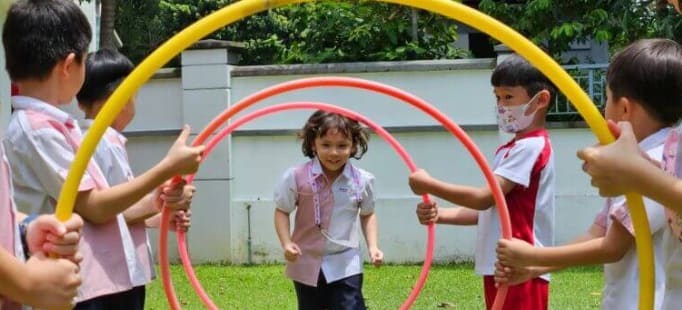
This continuous adaptation to sensory-rich, unpredictable stimuli fosters deep neuroplasticity, ensuring that their gross and fine motor skills become highly adaptable to real-world physical challenges rather than just sterile, predictable indoor scenarios.
Why the “Wild” is Better Than the Living Room
When we talk about motor development in children, we often think of milestones like crawling, walking, or holding a pencil. However, the environment where these skills are practiced matters immensely. Indoors, the floor is usually flat, the temperature is controlled, and the obstacles are predictable. The outdoors, on the other hand, is full of “affordances“—a fancy psychology term for the invitations the environment offers for action. A flat floor invites walking; a hill invites running, rolling, or sliding.
The unpredictability of nature is what sparks rapid development. A grassy field isn’t perfectly smooth; it has bumps, holes, and texture. Walking across it requires micro-adjustments in the ankles and core that a carpeted floor doesn’t demand. This constant need to adapt to the terrain strengthens the connection between the brain and the body.
It forces the child to be present, to judge distances, and to adjust their force—skills that are foundational for everything from sports to simply not tripping over their own feet.

Furthermore, outdoor play is rarely linear. In a hallway, you walk back and forth. In a park, a child might sprint, then stop abruptly to look at a bug, then jump over a puddle, and finally crawl under a bush. This variety of movement patterns recruits different muscle groups and promotes “physical literacy.” It builds a body that is capable, resilient, and ready for whatever physical challenges life throws its way.
Explosion of Gross Motor Skills: Running and Jumping
Gross motor skills involve the large muscles of the body that enable us to walk, run, jump, and maintain balance. There is no better place to develop these than the great outdoors, where the scale of the environment matches the need for big movements. Unlike the living room, where a thrown ball might break a vase, the park allows for maximum effort. Children can throw harder, run faster, and jump higher, pushing their physiological limits in a safe space.
Mastering Balance on Uneven Ground
One of the most critical aspects of gross motor development in children is the vestibular system—the inner ear mechanism that controls balance. When kids play outside, they are constantly challenging this system. Walking along a fallen log, hopping from stone to stone in a creek, or simply running down a steep hill requires intense focus and equilibrium.
These activities do more than just tire them out; they wire the brain for stability. A child who spends hours navigating the uneven terrain of a forest floor is developing a strong core and a sense of where their body is in space (proprioception). This body awareness is what eventually helps them sit still in a chair at school without falling off or navigate a crowded room without bumping into everyone.
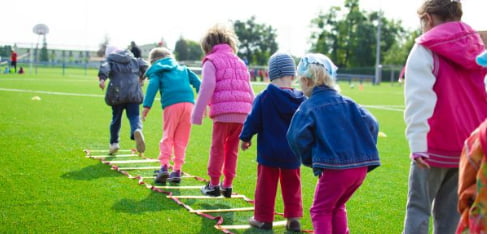
The Strength of Climbing and Hanging
Look at a playground or a park, and you will see children instinctively trying to get higher. Whether it is monkey bars or the low branches of an oak tree, pulling their own body weight against gravity is the ultimate strength training. This heavy work is crucial for developing upper body strength and shoulder stability.
Strong shoulders might not seem important for a toddler, but they are actually the foundation for fine motor skills later on. You cannot control a pencil with your fingers if your shoulder and arm aren’t stable enough to support your hand. By climbing trees and hanging from bars, children are secretly preparing their bodies for the classroom, building the endurance they will need for writing and drawing.
Fine Motor Skills: It’s Not Just About Pencils and Scissors
While we usually associate the outdoors with running and jumping, nature is also a treasure trove for fine motor development. Fine motor skills involve the small muscles in the hands and wrists, which are essential for tasks like buttoning a shirt, using utensils, and eventually writing. The outdoors provides an endless supply of “loose parts”—sticks, stones, leaves, acorns, and flowers—that require delicate handling and manipulation.
When a child picks up a tiny ladybug without squishing it, they are practicing “grading of force,” a sophisticated motor skill. When they try to thread a pine needle through a leaf or stack awkwardly shaped rocks, they are refining their hand-eye coordination. These natural toys don’t come with instructions, so children have to use their hands in new and creative ways to make them work, building dexterity that plastic toys with fixed functions often don’t provide.

The Magic of Mud Pies and Sensory Play
Let’s talk about the mess. We know laundry is a pain, but digging in dirt, sand, and mud is incredible for motor development in children. The resistance of the earth strengthens the muscles in the hands and fingers. Squeezing wet mud, crumbling dry leaves, or sifting sand provides rich sensory feedback that helps the brain map out the hand.
This tactile experience is vital. The more a child touches different textures, the better their brain becomes at controlling their fingers. Making a mud pie isn’t just messy play; it’s a pre-writing workout. It involves scooping, patting, molding, and decorating—all actions that isolate the fingers and build the pincer grasp they will use to hold a crayon.
Collecting and Sorting Nature’s Treasures
Have you ever gone for a walk and ended up carrying a pocketful of rocks? That collecting instinct is a fine motor workout in disguise. Picking up small objects like pebbles, seeds, or flower petals requires a precise pincer grasp (using the thumb and index finger).
Sorting these treasures into piles creates a cognitive link to these motor skills. As they organize their loot by size or color, they are using their hands to rotate and inspect each item. This repetitive, focused handwork builds the muscle memory and endurance needed for intricate tasks, all while they are simply enjoying the thrill of discovery.

Risk-Taking and Motor Development Planning
One of the most overlooked benefits of outdoor play is the development of motor planning—the ability to conceive, plan, and carry out a physical task. When a child looks at a stream they want to cross, their brain has to calculate the distance, decide how much force to use, predict if the landing spot is slippery, and then execute the jump. This rapid-fire problem solving is essential for agile movement.
The outdoors provides “risky play” opportunities that are vital for this learning. We aren’t talking about genuine danger, but rather situations where a child can test their limits. Can I jump from this stump? Can I reach that branch? When children take these calculated risks, they learn about their own body’s capabilities. If they fail and scrape a knee, they learn to adjust their motor plan for next time. This trial-and-error process builds not just physical skills, but confidence and resilience.
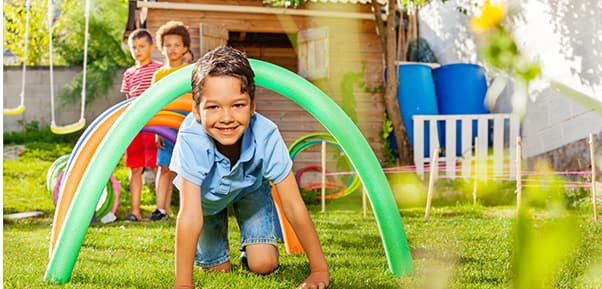
Overcoming the “Indoor Generation” Trap
We live in a time where screens are everywhere and safe outdoor spaces can feel scarce. It is easy to feel guilty about not getting out enough, but improving motor development in children doesn’t require a hike in a national park every weekend. It starts with small, intentional shifts in how we view “playtime.” It’s about prioritizing free movement over structured activities and recognizing that a bored kid in a backyard is often a kid who is about to invent a game that challenges their body in new ways.
The goal isn’t perfection; it’s progress. It’s about opening the door and saying, “Go play.” It is about suppressing the urge to say “Be careful!” every five seconds (unless there is real danger) and letting them stumble so they can learn to catch themselves. By valuing these outdoor experiences, we are giving our children the physical foundation they need to navigate the world with strength and confidence.
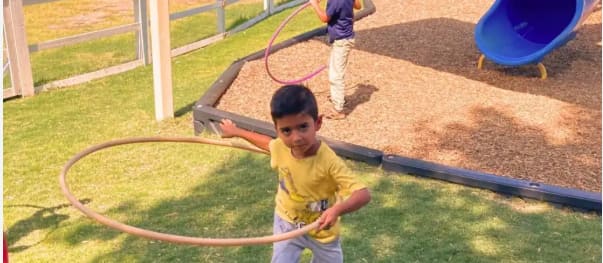
Start Small: The 15-Minute Rule for Motor Development
If you are overwhelmed, start with just 15 minutes a day. You don’t need a destination. A walk around the block where the child is allowed to balance on the curb or jump over cracks in the sidewalk counts.
Consistency beats intensity. Short, frequent bursts of outdoor play are better than one long trip to the park once a month. Those 15 minutes of fresh air give the sensory system a reset and allow those little muscles to stretch and work in ways they haven’t all day.
Motor Development Mechanics: Indoor vs. Outdoor Play
| Movement Category | Predictable Indoor Environment | Dynamic Outdoor Environment | Primary Motor Benefit |
| Balance & Agility | Walking on flat, carpeted or wooden floors. | Navigating uneven dirt trails, tree roots, and slanted hills. | Forces rapid, micro-adjustments in the ankles and core, perfecting equilibrium. |
| Core Strength | Sitting in structured chairs or playing on the floor. | Pushing heavy wheelbarrows, climbing boulders, or hanging from branches. | Engages deep trunk stabilizers necessary for posture and future seated focus. |
| Fine Motor Skills | Pressing flat buttons or playing with standardized plastic blocks. | Picking up tiny acorns, snapping irregular twigs, and molding wet mud. | Refines the pincer grasp and builds intrinsic hand muscles for handwriting. |
| Spatial Awareness | Moving within confined, easily measurable, familiar rooms. | Running through open fields and judging the distance between stepping stones. | Enhances proprioception and the ability to safely navigate unpredictable environments. |
Frequently Asked Questions (FAQ)
How does playing on uneven ground specifically improve balance?
Playing on uneven ground drastically improves balance by constantly forcing the child’s ankles, knees, and core muscles to make rapid, micro-adjustments to maintain stability. When walking across a rocky trail or a slanted grassy hill, the proprioceptive system sends continuous feedback to the brain about the body’s precise position in space.
What are the best outdoor activities for building core strength?
The most effective outdoor activities for building core strength involve heavy work and unstructured climbing, such as scrambling up large boulders, hanging from sturdy tree branches, or pushing heavy wheelbarrows filled with dirt. These child-led, full-body movements require the abdominal and back muscles to engage deeply in order to stabilize the spine against the pull of gravity.
How does outdoor play support fine motor skill development?
Outdoor play naturally supports fine motor development skill by providing a limitless array of complex, varied textures and small, irregular objects that require precise, intentional finger manipulation to explore. Activities like carefully picking up tiny pebbles, pulling individual petals off a wildflower, or weaving long blades of grass together actively strengthen the intrinsic muscles of the hand and perfect the vital pincer grasp.